

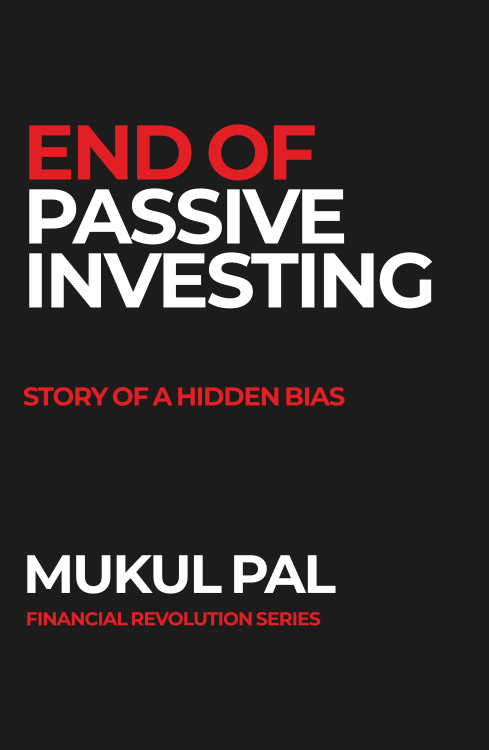
Every research note on this site is a bore-hole into one question: what exactly is wrong with the index? The book is the whole excavation. It begins a century and a half back — with the first price-index formulas — and shows that the bias active managers fight today was not an accident of modern markets. It was written into the arithmetic from the start, then inherited by every stock index, every benchmark, and every passive product built on them.
The foreword’s framing is blunt: “the very foundation of modern investing—indexation—is not the neutral, unbiased mechanism it claims to be.” What follows is the story of how that happened, told through the people who built the machinery — and the statistics they left unexamined.
What the book argues
Three claims carry the volume. First, the index is a design, not a mirror — committees, formulas and float rules all embed choices, and choices embed bias. Second, the bias is statistical, not moral: cap-weighting mistakes size for information, which is why value investing struggles, momentum looks like a factor, and the rich get richer. Third — the constructive turn — a probability-based re-weighting can strip the bias out while keeping everything an allocator needs a benchmark to be.
| Part 1 · Origins | From Archimedes to the grandmother’s lawsuit; how Laspeyres, Paasche and their successors baked a bias into the index formula itself. |
| Part 2 · The barometer | The early stock indexes and their architects — and the illusions that accompanied the birth of modern passive investing. |
| Part 3 · Contradictions | Value’s statistical vulnerabilities, the mediocrity paradox, momentum as just another factor — and why the rich get richer. |
| Part 4 · Consequences | The tale of two sacks, the S&P 500 myths, and the governance failures that point toward implosion. |
| Part 5 · Reinvention | A dip in the probability urn — and the rise of the intelligent, augmented investor. |
Where the research fits
Readers of these notes will recognise the book’s skeleton. Chapter 8’s rich-get-richer machinery is the winner bias of Reinventing Benchmark Construction; Chapter 9 expands The S&P 500 Myth; and Part 5’s probability urn is the engine behind the Mean Reversion Framework and the 3N model. The book is where the twenty-year argument gets told in order, for a reader who was never going to open SSRN.
- Indexation’s bias is inherited from its 19th-century formulas — not a quirk of modern markets.
- The consequences are measurable: distorted price discovery, concentration, and an active industry benchmarked to a flawed default.
- The fix is constructive: probability-based indexing — the research program this firm runs.

Pal, M. (2025). End of Passive Investing: Story of the Hidden Bias. 332 pages. Complimentary copies go to allocators, managers, press and academics.
This note is provided for information and discussion purposes only. It does not constitute investment advice, investment research, a recommendation, or an offer or solicitation to buy or sell any security or investment product, and it should not be relied upon for any investment decision. Views are drawn from the referenced paper as of its publication date and are subject to change without notice. Exhibits are illustrative unless otherwise stated and do not depict the performance of any actual portfolio; hypothetical and idealized results have inherent limitations and do not reflect actual trading. Past performance does not guarantee future results. AlphaBlock Technologies Inc. is a financial-technology licensor; regulated products are offered solely by licensed partners in their respective jurisdictions under their own documentation. © 2026 AlphaBlock Technologies Inc.