 α1phablock
THESIS
α1phablock
THESIS
// The hidden bias of indexation
The end of passive investing.
“The very foundation of modern investing — indexation — is not the neutral, unbiased mechanism it claims to be.”
01 The scale
$50T
tracks index benchmarks worldwide
The largest allocation decision in finance runs on one rule.
Market-capitalisation weighting — the default that decides where the world's capital sits. Adopted so widely it's no longer examined. It should be.
02 The origin
The index is 150 years old — and so is its bias.
The formulas underneath it predate modern markets. The bias wasn't an accident — it was written into the arithmetic from the start.
Laspeyres price-index formula
Dow Jones — the first stock index
The S&P 500
The first retail index fund
$50T indexed · passive overtakes active
03 A design, not a mirror
The index is a design — not a mirror.
We treat it as a neutral reflection of the market. But every index is built from choices — and choices embed bias.
Committees
choose which companies are in — and which are not.
Formulas
choose how much of each — weight by size, not by merit.
Float rules
choose what even counts as investable.
Three design decisions — one inherited bias.
04 The bias
It mistakes size for information.
Cap-weighting rewards a stock for being big, not for being right — a self-reinforcing loop that mistakes momentum for merit.
A stock rises
→
it earns a bigger weight
→
the index buys more
→
it rises again ↺
The rich get richer — regardless of whether the price was ever right. It's why value struggles and momentum looks like a factor.
The flaw is statistical, not moral — no one chose it; everyone inherited it.
05 The consequences
An unexamined default has a cost.
Price discovery distorts
Flows chase weight, not value — capital follows what already rose.
Risk concentrates
A shrinking handful of names comes to dominate the benchmark — and every portfolio that tracks it.
The scorecard is flawed
The active industry is judged against a biased default — so beating it looks like heresy, not arithmetic.
06 The S&P 500 myth
The benchmark everyone trusts was never an optimum.
We treat the S&P 500 as the market itself — a neutral, unbeatable standard. It is a committee's design with a cap-weighted formula: a choice, not a law of nature.
Once you can see the bias, beating it stops being heresy.
It becomes arithmetic.
After Pal, “The S&P 500 Myth” (2022) — one of nineteen papers behind this thesis.
07 The constructive turn
If the bias is statistical, it can be removed.
Re-weight by the probability of growth instead of by size, and you keep everything a benchmark must be — while stripping the bias out.
Keep
Broad, rules-based, investable — everything an allocator needs.
Remove
The rich-get-richer weighting that rewards size over merit.
Result
A model broad enough to track the market, tilted enough to beat it.
08 The evidence
The thesis isn't just argued — it's measured.
Rebuilt benchmark · Nasdaq RMIVG 2011.2×
Cap-weighted benchmark3.2×
Growth of 100 · calculated from 2004, listed on Nasdaq 2014–21 (17 yrs).
+8.24%
weighted alpha across 12 mandates
simple average +6.63%
10 / 12
mandates beat their cap-weighted benchmark
09 The case study · the S&P 500
The S&P 500, beaten from every starting point.
Since January 2014, an E&R portfolio launched every month-end — 324 in all — run on one-, two- and three-year clocks, with no discretion. Not one lucky vintage: the whole grid.
+400 bps
average annual excess vs the S&P 500, since 2014 · modelled
324
monthly portfolios · every start date
0
discretion · rules-based, start to finish
Beating the benchmark wasn't a call — it was the design, provable from any date you pick.
Systematic study from “Machine Beta” (SSRN 4702741) — every month-end start since Jan 2014.
10 The research
Derived in the open — not asserted from a stage.
15+ yrs
of published research
19
peer-visible papers on SSRN
Two decades of work, from the origins of the index formula to the probability model that replaces it.
α1phablock
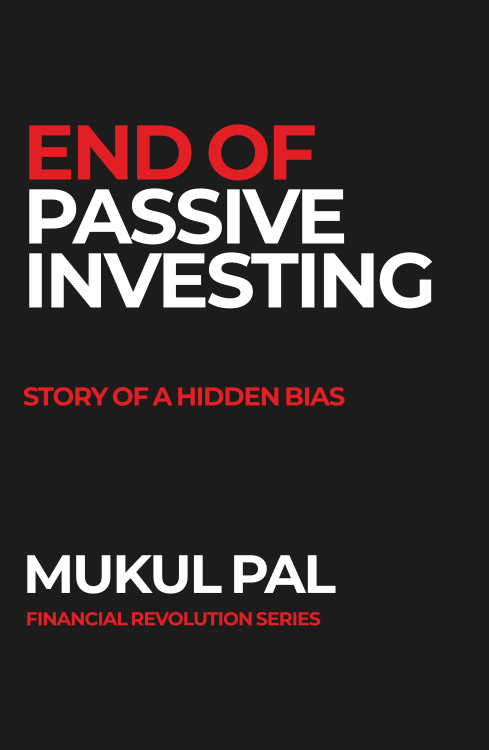
// The whole argument, in order
The index was never neutral.
End of Passive Investing: Story of the Hidden Bias. Two decades of research in one volume — 332 pages.
Read it
amazon.com · B0FCB361V5
Contact
contact@a1phablock.com
Once you see the bias, you can build past it.
Performance shown was achieved in live, regulated portfolios by managers licensed to use the 3N™ methodology — not by any AlphaBlock-managed fund. Sources: Nasdaq (public index record) and SEBI-regulated PMS disclosures, independently tracked on PMS Bazaar; India figures are gross of fees. Figures marked modelled are simulated, not live — they do not represent actual trading and exclude costs that would apply to a real account. The +8.24% weighted alpha, +6.63% simple average and 10/12 count are our aggregates across those records. Past performance does not guarantee future results. This document is for information only — not an offer, a solicitation, or investment advice. For qualified recipients only.